
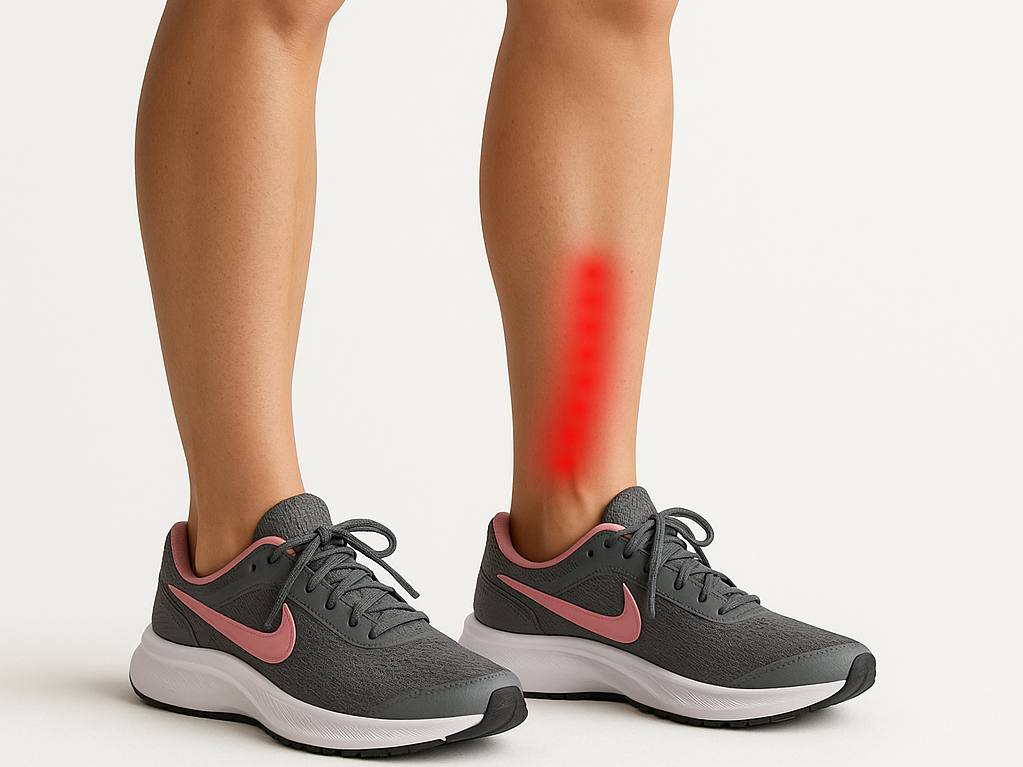
Ever feel a dull ache along the inside of your shin after a run or workout? It often starts small, just some soreness after exercise, then sticks around and can get worse if nothing changes. If that sounds familiar, you could be dealing with Medial Tibial Stress Syndrome, better known as shin splints. It is one of the most common lower leg complaints in runners, dancers and anyone building up their training, and it is something I see regularly in the clinic in Sandton.
This article explains what MTSS is, why it happens, how it is assessed, what treatment involves, and when it is worth getting checked. The reassuring part is that it usually settles well once the load is managed and the causes are addressed.
The Short Version
MTSS, or shin splints, is load-related pain along the inner shin. It develops when repeated running or jumping loads the tibia and surrounding tissue faster than it can adapt, so the ache tends to spread along the inner shin rather than sit at one sharp point. It usually improves when you settle the aggravating load and then gradually rebuild your running and leg capacity, rather than pushing straight through it or stopping everything completely. Recovery varies, often from a few weeks to a few months. It is worth getting checked if the pain becomes sharp and focused on one spot, is there when you walk, or is noticeable at rest, so a stress fracture can be ruled out.
If shin pain is already limiting your training, a proper assessment is the best place to start.
 Make Your Booking
 Chat on WhatsApp
What Is Medial Tibial Stress Syndrome (MTSS)?
Medial Tibial Stress Syndrome, or MTSS, is what most people call shin splints. It is the pain felt along the inner edge of the shin, usually brought on by running, jumping or a lot of walking. It develops when repeated loading exceeds the current capacity of the tibia and the surrounding tissues to adapt. That is why the pain is spread along the inner border of the shin rather than sitting in one sharp spot.
It is not a broken bone. But continuing to train hard on a painful shin without adjusting the load can keep the area irritated and, in some cases, increase the risk of a higher-grade tibial bone stress injury, including a stress fracture.1
How Common Is It?
Shin splints are common. Around 1 in 5 runners will deal with them at some point, and in military settings, where recruits go through intense physical training, the reported figure can be higher still.1
Reported rates are also higher in women than men, which is thought to relate to differences in body shape and how the foot and leg load. Factors like flat feet or a higher body mass index may also make it more likely.
Who Usually Gets It?
You are more at risk if you:
- Have just started a new training programme
- Increased your running or training load too quickly
- Do a lot of high-impact activity like running, dancing or basketball
- Train in worn-out or unsupportive shoes
- Have flat feet or limited ankle control
Common Signs and Symptoms of MTSS
- A dull ache along the inner shin that you may notice along the lower half of the shin, especially after running or jumping.
- Pain that eases then returns. It may settle as you warm up but often comes back later during or after the session.
- Tenderness over a stretch of shin. Pressing along the inside of the shin can feel sore over a long portion, not just one small point.
- Pain that lingers after exercise, sometimes hours later or into the next day.
- Morning soreness in the shin when walking the day after a hard session.
- Both legs affected. MTSS can involve both shins at once, not just one leg.
- Worse on hard surfaces or downhill, where the load through the shin is higher.
- Tight or stiff calves that may feel harder or less flexible than usual.
- Possible mild swelling along the inside of the shin after exercise.
- Often no pain at rest early on, unless the problem has progressed.
- Usually no sharp, pinpoint pain. Unlike a stress fracture, the pain tends to spread over a wider area rather than sitting in one specific spot.
Why Does MTSS Happen?
If you are dealing with shin splints, one of the first questions is usually: why is this happening to me? Here is what tends to be going on.
Repeated Load on the Shinbone
MTSS develops because of repeated load on the shinbone (the tibia), especially along the inner edge. Every time your foot strikes the ground while running, jumping or walking quickly, the muscles pull on the bone.
If that load is more than the tissue can currently handle, or happens too often, the bone and the tissue around it, including the covering of the bone (the periosteum), become irritated and overloaded. Over time this shows up as pain along a stretch of the shin. It is the body signalling that it needs the load eased.1
A Bone-Stress Picture
MTSS is best understood as part of a bone-stress continuum. It is not a stress fracture, but the shinbone is being asked to adapt to more load than it is ready for. Bones normally get stronger with use, but if the load is too high and there is not enough recovery, the bone cannot keep pace, and pain follows.1
Movement and Muscle Factors
Your body works as a chain, so how your foot lands and how your hips control movement changes how the muscles load the shin. A flat foot, for example, can make the lower leg muscles work harder. Tight calves, weaker hips or less efficient running form can add to the strain, so the bone has more to cope with over time.2
Mostly a Load Balance Problem
At its core, MTSS is about doing more than your body can handle right now. That often means building training up too quickly, running many days in a row, not allowing enough recovery, or footwear that does not suit you. The result is that the shins take on more than they are ready for.
What Other Conditions Could It Be?
Here are five conditions that can be mistaken for MTSS, roughly from more to less common, and how to tell them apart.
Tibial Stress Fracture
This is the most important one to distinguish from MTSS. The pain is usually sharper and focused on one small spot rather than spread along the shin. It can be present at rest or when walking, not only during exercise, and pressing on that one point often hurts noticeably more.1
Chronic Exertional Compartment Syndrome (CECS)
This tends to feel like tightness, pressure or burning during exercise that usually eases within a few minutes of stopping. It often affects the front or outside of the lower leg and can come with numbness or tingling in the foot.1
Posterior Tibial Tendinopathy
This affects the tendon that supports the arch. The pain is felt behind the inside of the ankle rather than along the shin, and it often worsens with prolonged standing or walking. The arch may look flatter than usual. It does not usually hurt directly over the shinbone as MTSS does.
Popliteal Artery Entrapment Syndrome (PAES)
This is much rarer, but it can cause lower leg pain while running when a blood vessel behind the knee is compressed. The pain usually settles quickly once you stop. Some people also notice coldness in the foot or a change in foot colour. It is generally investigated with a scan once other causes are ruled out.
Nerve Entrapment (for example, Saphenous Nerve)
Occasionally a nerve in the leg is irritated, causing burning or tingling pain that can feel like it spreads rather than staying in one area. Unlike MTSS, it does not always follow activity and may be triggered by certain positions or movements.
Common Mistakes When Managing MTSS
Trying to Push Straight Through It
Toughing it out without changing anything tends to keep the shin irritated and slows things down. Easing the load early usually gets you back to full training sooner than repeatedly training through the pain.
A Short Break, Then Straight Back In
A few rest days can settle symptoms, but going straight back to the old routine often brings the pain back. The load needs to be rebuilt gradually rather than resumed all at once.
Ignoring Footwear
Old or unsupportive shoes can make the lower legs work harder than they need to. Replacing worn shoes or improving support often helps.
Skipping Strength and Mobility Work
MTSS often involves weaker hips, tight calves or less efficient movement. If strengthening and mobility work are skipped, the problem tends to settle only temporarily and return when load goes back up.
What Happens If You Keep Training Through It?
Shin splints often settle when the load is managed and the causes are addressed. Continuing to train without adjusting the load can keep the area irritated and may increase the risk of a higher-grade tibial bone stress injury. That is not a reason to panic. It is a reason to adjust your training early.
How Long Does It Take to Settle?
Recovery varies. Many people settle over several weeks, and more stubborn cases can take a few months. It depends far more on managing the load and addressing the causes than on a fixed timeline. With sensible progression, most people return to training with their symptoms under control and the capacity to handle the load they want.
When Should You Get Your Shin Checked?
Most shin splints settle with sensible load management and do not need urgent care. A few signs are worth getting checked properly rather than training through.
Arrange a prompt assessment if you notice:
- pain that becomes sharp and focused on one small point of bone
- shin pain that is there when you walk, or that is noticeable at rest or at night
- pain that is not settling despite easing your training and addressing the causes
- a rapid increase in pain or swelling over a short period
Seek urgent medical care if you have sudden, severe shin pain and cannot put weight on the leg after a specific incident, which needs assessing to rule out a fracture.
These signs do not always mean something serious, but they are worth checking rather than guessing.
When Are Scans Needed?
MTSS is usually diagnosed from your symptoms and a physical examination. A scan is not routinely needed when the presentation is typical. Imaging may be considered when the pain is sharply focused on one point, occurs during walking or at rest, is not improving as expected, or when a tibial stress fracture or another condition needs to be ruled out.1
X-Ray
X-rays may be used first but are often normal in MTSS, and they can also miss an early stress fracture. They are mainly there to help rule out other bone problems.
MRI
MRI is usually the most useful scan when a higher-grade bone stress injury is suspected, because it can show changes within the bone before they appear on an X-ray. In MTSS it may show swelling around the bone and changes in its lining.
Bone Scan
A bone scan can identify areas of increased bone activity. In MTSS this tends to show along a stretch of the inner shin, whereas a stress fracture usually shows a smaller, more focused hot spot. Bone scans are used less often now that MRI is widely available.
Is Surgery Needed?
The good news is that surgery for MTSS is almost never needed. Most people recover with rest, the right rehabilitation and sensible changes to how they train. MTSS responds well to non-surgical treatment, especially when it is addressed early.
In the rare cases where surgery is discussed, it is only after a long period of pain and a full course of conservative care, and even then the decision is made carefully. More commonly, surgery only comes into play if a stress fracture develops and does not heal on its own, which is a separate situation from MTSS.2
Treatment Options for MTSS
As a physiotherapist, here is what I want you to know: MTSS can be managed without surgery in nearly every case. With the right mix of rehabilitation and a plan matched to your body, most people settle well and return to training with symptoms under control and the capacity to handle their usual load. The clear priority is load management and exercise. The other options below are helpful add-ons, not the main event.
Exercise Therapy and Load Management
This is the foundation of recovery. The aim is to reduce the load on the shin, then rebuild the capacity of the leg so it can handle your training again. Typically that includes calf and lower-leg strengthening, hip and glute work, balance and ankle control, and a gradual return-to-running plan, alongside sensible adjustments to how much and how often you train.2
Myofascial Release
Myofascial release can help reduce discomfort in tight or sensitive calf muscles and make movement or rehabilitation exercises feel easier. It is an adjunct to load management and strengthening, rather than a treatment that removes stress from the tibia by itself.
Orthopaedic Manual Therapy
Gentle hands-on techniques can help stiff joints and muscles move more freely. If the foot, ankle or hips are moving poorly, it can change how load passes through the shin. Manual therapy is used to support easier movement alongside your exercise programme, not as a standalone fix.
Laser Therapy (Low-Level Laser Therapy)
Low-level laser therapy may be used as an adjunct to help with comfort while training load and rehabilitation are addressed. It is not a substitute for modifying the activity that is aggravating the shin or rebuilding the leg’s capacity. Overall the evidence for laser specifically in MTSS is limited, so it is best seen as an optional extra rather than a core treatment.3
Dry Needling
Dry needling uses fine needles to target tight or tender points in the calf muscles. Some people find it helps reduce muscle discomfort and makes their rehabilitation feel more comfortable. Like the other hands-on options, it supports the exercise plan rather than replacing it.
Taping and Strapping
Taping can add some short-term sensory support and comfort while the shin settles. It works by supporting movement and comfort, not by lifting the skin to decompress deeper tissues, and it does not fix MTSS on its own. It can make it easier to stay active while the underlying load and capacity are addressed.2
Education and Smart Training
Knowing when to push and when to ease off is a big part of recovery. That includes adjusting your training plan, choosing suitable surfaces and shoes, mixing in low-impact options like swimming or cycling, and watching for early signs of overload. Training in a way your body can adapt to is what keeps symptoms settled.
Conclusion
Shin pain from MTSS does not have to hold you back for good. It is a load-related problem, and it usually responds well to easing the aggravating load, addressing the causes, and gradually rebuilding the capacity of your legs.
I have worked with many people who came in frustrated by shins that kept flaring up. With a clear plan and a bit of patience, most get back to running and training with their symptoms under control. If you would like a hand working out what is driving yours and how to get back to full training, I am happy to help.
Ready to take the next step? Book a session at Daniel da Cruz Physiotherapy in Sandton.
About the Author
Daniel da Cruz is a physiotherapist in Sandton, registered with the HPCSA. He holds a Bachelor of Physiotherapy (BPhysT) from the University of Pretoria and works with runners and active people managing lower limb and running-related injuries, including shin splints, using assessment, graded exercise and hands-on treatment. He combines evidence-based rehabilitation with practical advice to help people reduce their injury risk and return to the activities they value.
References
- Bhusari N, Deshmukh M. Shin Splints (Medial Tibial Stress Syndrome). In: StatPearls. Treasure Island (FL): StatPearls Publishing. Available at: https://www.ncbi.nlm.nih.gov/books/NBK538479/ ↩
- Galbraith RM, Lavallee ME. Medial tibial stress syndrome: conservative treatment options. Current Reviews in Musculoskeletal Medicine. 2009;2(3):127–133. Available at: https://www.ncbi.nlm.nih.gov/pmc/articles/PMC2848339/ ↩
- Winters M, Eskes M, Weir A, Moen MH, Backx FJG, Bakker EWP. The treatment of medial tibial stress syndrome: a systematic review. Sports Medicine. 2013;43(12):1315–1333. Available at: https://pubmed.ncbi.nlm.nih.gov/23979968/ ↩
Disclaimer
This article is for informational and educational purposes only and is not a substitute for individual medical advice. Always consult a suitably qualified healthcare professional about your own symptoms, especially before starting or changing a training programme.
Leave a Reply