
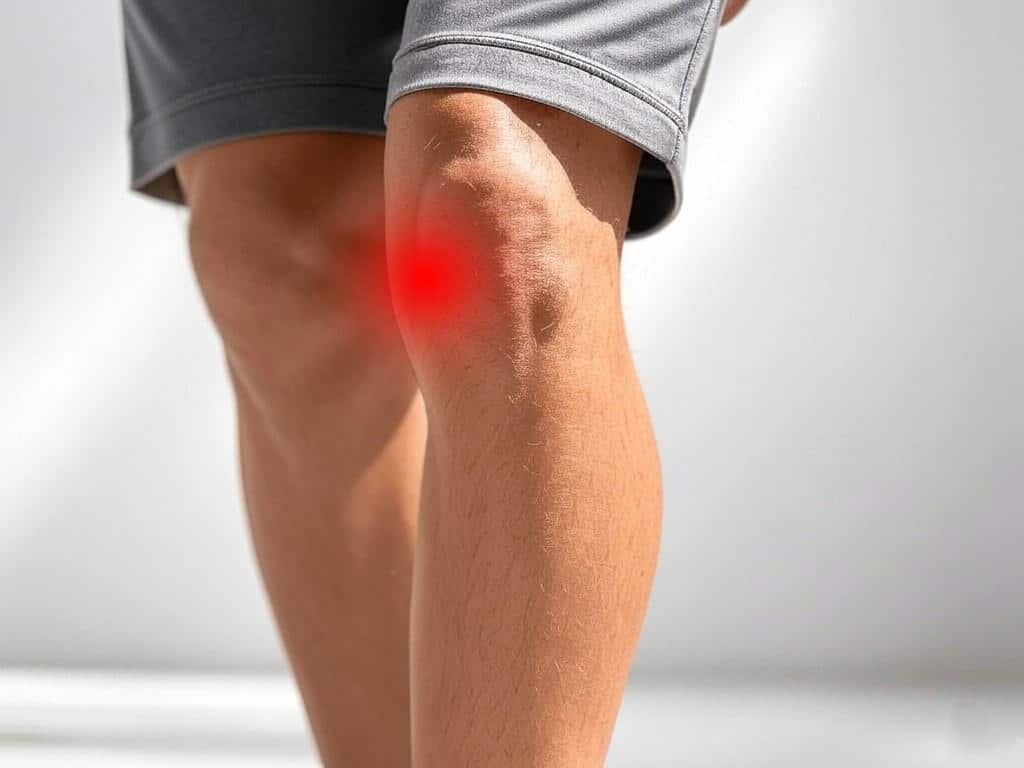
Your knee relies on a small but important piece of cartilage to stay comfortable under load. When the medial meniscus, the cushion on the inside of the knee, is irritated or torn, everyday things like squatting, twisting or going down stairs can become uncomfortable.
The medial meniscus is made of fibrocartilage, a tough, rubbery tissue that helps absorb load and keep the knee stable. Tears come in two broad types: fresh tears from a twist or injury, and gradual, age-related tears that are very common and often show up on scans even in people with little or no pain.1, 2
This article explains what a meniscus tear is, how it is assessed, what treatment involves, and when it is worth being seen in person. The reassuring part is that many tears, especially the age-related kind, are managed well without surgery.
The Short Version
A medial meniscus tear affects the fibrocartilage “cushion” on the inside of the knee. Tears come in two broad types: fresh ones from a twist or injury, and gradual, age-related ones that are very common and often show up on scans even without much pain. Many meniscus tears, especially age-related tears, improve or become manageable with load management and a progressive exercise programme rather than surgery. Surgery is considered in specific situations, mainly a fresh tear that stops the knee straightening or a tear that can be repaired. See someone promptly if your knee is truly stuck and will not straighten, or if you cannot put weight on it.
Dealing with knee pain that will not settle? A proper assessment can work out what is driving it and the best way forward.
 Make Your Booking
 Chat on WhatsApp
What Is a Medial Meniscus Tear?
The meniscus is a C-shaped piece of fibrocartilage that sits between the thigh bone (femur) and shin bone (tibia). There are two in each knee: the medial meniscus on the inside and the lateral meniscus on the outside. Together they spread load across the joint, absorb shock and help keep the knee stable.1
A medial meniscus tear describes a split or structural change in this fibrocartilage. It may happen suddenly during an injury, for example twisting the knee while the foot is planted (a traumatic tear), or develop gradually as the tissue changes with age (a degenerative tear). These two types behave differently and are managed differently, so telling them apart matters.
Who Gets Meniscus Tears?
Traumatic tears are more common in younger, active people, often during sports that involve twisting, pivoting or awkward landings. Degenerative meniscal changes are often seen alongside knee osteoarthritis and become more common with age, and can turn up on a scan done for another reason.2 Body weight and the overall demands placed on the knee can also influence symptoms and how the joint is loaded.
Are All Meniscus Tears the Same?
No. Meniscus tears differ in how they happened, their shape, where they are, whether a piece has moved out of place, and whether the knee is truly locking. An age-related tear picked up on a scan may not be the main reason for your pain. A fresh, displaced tear that stops the knee from straightening is a different situation and needs a different approach. That is why a scan result has to be read together with your symptoms and a physical examination, not on its own.
You might hear tears described by their shape, for example longitudinal, radial, horizontal, flap, bucket-handle or root tears. You do not need to memorise the list. What matters is how the knee is behaving and how it is affecting you day to day.
Common Signs and Symptoms
You may notice some or all of these:
- Pain on the inside of the knee, often with walking, squatting or twisting.
- Swelling, which may build up over the first day or two after a fresh injury.
- Stiffness or trouble fully bending or straightening the knee.
- Clicking or catching during movement.
- A sense of the knee giving way, often from pain or reduced control.
- Tenderness along the inner joint line when you press on it.
- Discomfort putting full weight through the leg, especially soon after a fresh injury.
- Symptoms that come on gradually, which is more typical of an age-related tear.
- The knee becoming physically stuck so it will not fully straighten. This is true locking, and it is different from ordinary clicking (see the safety section below).
What Other Conditions Could It Be?
Knee Osteoarthritis
Osteoarthritis develops gradually as the joint changes over time. The pain tends to build with activity and comes with stiffness, particularly after rest. It often overlaps with degenerative meniscus changes, which is one reason a scan finding has to be read alongside the whole picture.
Patellofemoral Pain Syndrome
This causes pain around or behind the kneecap, often with stairs, squatting or prolonged sitting. Unlike a meniscus tear, it does not cause true locking, and the pain sits at the front rather than along the inner joint line.
Ligament Injuries (ACL or MCL)
Ligament injuries are usually linked to a clear incident and tend to cause a feeling of the knee giving way or being unstable, often with rapid swelling. A meniscus tear and a ligament injury can happen together, so both are checked during an examination.
Bursitis
Irritation of one of the small fluid-filled sacs around the knee causes localised swelling and tenderness in one spot, without the catching or true locking seen with a meniscus tear.
Patellar Tendinopathy
This causes pain in the tendon just below the kneecap, usually from overuse and most noticeable with jumping and landing. The pain is focused on the tendon rather than along the inner joint line.
Common Mistakes When Managing a Meniscus Tear
Pushing Straight Through a Painful, Swollen Knee
Training hard through a knee that is sore and swollen tends to keep it irritated and slows things down. Temporarily adjusting the aggravating load can help settle symptoms while you keep the knee moving and begin rebuilding its capacity.
Resting Completely and Avoiding All Movement
Long periods of complete rest can leave the knee stiff and the surrounding muscles weaker, which does not help recovery. Gentle movement and graded exercise are usually better than doing nothing.
Skipping the Strengthening
Progressive strengthening helps rebuild the capacity of the knee and surrounding muscles for walking, stairs, sport and other activities. Leaving it out can make it harder to return confidently to the loads you need to tolerate.
Expecting a Scan to Give All the Answers
A scan is one piece of information, not the whole story. Because meniscus changes are common on scans even in people with no pain, the findings have to fit your symptoms and examination to be useful.2
When Are Scans Needed?
A meniscus problem is worked out first from your history and a physical examination. A scan is not automatically needed for everyone with pain on the inside of the knee.
An MRI is the most useful scan when a fresh meniscus tear is suspected and the result would change your treatment, especially if the knee is locking, movement is restricted, or surgery is being considered. For knee pain that has come on gradually, an X-ray can be more useful if osteoarthritis is the likely cause.
One important point: meniscus changes show up on MRI in a lot of middle-aged and older people, including those with no pain at all. So a scan finding is not the diagnosis by itself. It only means something when it fits your symptoms and examination.2
Is Surgery Needed?
Rehabilitation and load management are the right first step for most age-related (degenerative) meniscus tears, and for many stable tears from an injury too. For degenerative tears, exercise-based physiotherapy produces knee-function results comparable with keyhole (arthroscopic) surgery for many people, and arthroscopy offers limited benefit for degenerative knee problems.3, 4, 6
Earlier review by an orthopaedic surgeon makes more sense when a fresh, displaced tear is stopping the knee from straightening, when a tear that could be stitched back is suspected, or when significant symptoms carry on despite a proper rehabilitation programme.5 Being young or sporty on its own is not a reason for surgery. What matters more is the type of tear, whether a piece has moved, whether it can be repaired, and how much it is limiting you.
When surgery is used, it may involve repairing (stitching) the tear, or trimming the torn portion while keeping as much healthy meniscus as possible. Either way, rehabilitation afterwards is what rebuilds strength and movement and guides a steady return to activity.
When to Have Your Knee Checked in Person
Most knee pain from a meniscus problem can be managed well, but a few situations are worth checking in person.
Have your knee assessed promptly if:
- it becomes physically stuck and you cannot fully straighten it, especially after a twisting injury
- you have had a significant injury with rapid swelling
- you cannot put weight on the leg
Arrange an assessment if:
- the knee repeatedly gives way
- your movement stays restricted
- your symptoms are not improving with sensible activity changes
Clicking or a brief catch that does not stop the knee moving is common and is not the same as a truly locked knee.
Treatment Options
Treatment is individualised and guided by your assessment. Exercise and load management form the core, and the options below are used alongside them to keep you comfortable and moving while you build strength.
Exercise Therapy and Load Management
This is the cornerstone. Progressive strengthening of the muscles around the knee and hip, together with balance work and a graded return to activity, shares the load across the joint and builds the leg’s capacity. For degenerative tears in particular, this is well supported as a first-line treatment.3
Myofascial Release
Myofascial release is used to ease discomfort in tight or sensitive muscles around the knee. As that discomfort settles, movement feels easier and you get more out of your strengthening exercises.
Orthopaedic Manual Therapy
Hands-on techniques are used to ease stiffness and help the knee and nearby joints move more freely. That improvement in movement makes it easier to progress your exercises and return to the activities you want to do.
Laser Therapy
Low-level laser therapy is used to ease discomfort while you work through your rehabilitation. Keeping you more comfortable makes it easier to stay consistent with your exercises.
Dry Needling
Dry needling targets tight or tender points in the muscles around the knee. Many people find it eases discomfort and makes movement feel easier, which helps them stay consistent with their exercises.
Taping and Strapping
Taping is used to give the knee short-term support and comfort while you build strength and return to activity. That added support can help you move with more confidence as you progress.
Frequently Asked Questions
Do I need surgery for a meniscus tear?
Most people, especially with age-related tears, do not. Rehabilitation is the usual first step, and surgery is kept for specific situations, mainly a fresh tear that stops the knee straightening, a tear that can be repaired, or ongoing significant symptoms after a proper rehabilitation programme.3, 5
Will it improve without an operation?
Often, yes. Many tears, particularly age-related ones, become manageable with load management and a progressive exercise programme, with outcomes comparable to keyhole surgery in studies of degenerative tears.4
Can I keep exercising?
Usually within comfortable limits. Rather than stopping everything, the aim is to adjust how much and how hard you load the knee so it is challenged but not overloaded, and build back up from there.
Do I need an MRI?
Not always. The diagnosis is made from your history and examination, and an MRI is mainly useful when the result would change your treatment, such as when the knee is locking or surgery is being considered.
How long does recovery take?
Recovery varies according to the type of tear, how irritable the knee is, your starting strength and the activities you want to return to. Progress is usually judged by improving movement, swelling, strength and function rather than by one fixed timeline.
Conclusion
A medial meniscus tear does not have to keep you from the activities you value. Many tears, especially age-related ones, improve or become manageable with load management and a progressive exercise programme, and surgery is kept for specific situations rather than being an automatic next step.
Recovery takes time and consistent effort, but each step, easing the aggravating load, building strength and gradually returning to activity, moves you forward. If knee pain is holding you back, I am happy to help you work out what is driving it and put together a clear plan.
Ready to take the next step? Book a session at Daniel da Cruz Physiotherapy in Sandton.
About the Author
Daniel da Cruz is a physiotherapist in Sandton, registered with the HPCSA. He holds a Bachelor of Physiotherapy (BPhysT) from the University of Pretoria and works with active people managing knee and lower-limb pain, including meniscus problems, using assessment, graded exercise and hands-on treatment. He combines evidence-based rehabilitation with practical advice to help people move more comfortably and return to the activities they value.
References
- Fox AJS, Wanivenhaus F, Burge AJ, Warren RF, Rodeo SA. The human meniscus: a review of anatomy, function, injury, and advances in treatment. Clinical Anatomy. 2015;28(2):269–287. https://doi.org/10.1002/ca.22456 ↩
- Englund M, Guermazi A, Gale D, et al. Incidental meniscal findings on knee MRI in middle-aged and elderly persons. New England Journal of Medicine. 2008;359(11):1108–1115. https://doi.org/10.1056/NEJMoa0800777 ↩
- van de Graaf VA, Noorduyn JCA, Willigenburg NW, et al. Effect of early surgery vs physical therapy on knee function among patients with nonobstructive meniscal tears: the ESCAPE randomized clinical trial. JAMA. 2018;320(13):1328–1337. https://doi.org/10.1001/jama.2018.13308 ↩
- Katz JN, Brophy RH, Chaisson CE, et al. Surgery versus physical therapy for a meniscal tear and osteoarthritis. New England Journal of Medicine. 2013;368(18):1675–1684. https://doi.org/10.1056/NEJMoa1301408 ↩
- American Academy of Orthopaedic Surgeons. Management of Acute Meniscal Pathology: Evidence-Based Clinical Practice Guideline. 2024. https://www.aaos.org/ampcpg ↩
- Thorlund JB, Juhl CB, Roos EM, Lohmander LS. Arthroscopic surgery for degenerative knee: systematic review and meta-analysis of benefits and harms. BMJ. 2015;350:h2747. https://doi.org/10.1136/bmj.h2747 ↩
Leave a Reply