
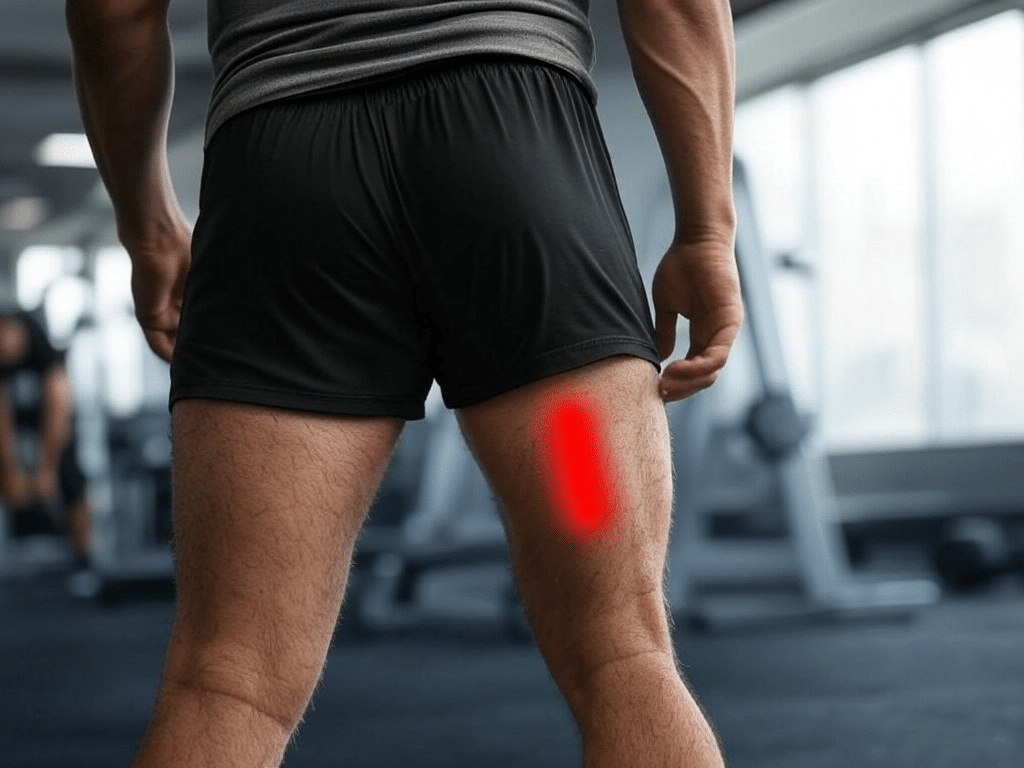
Ever pulled up mid-run with a sharp pain in the back of your thigh? That’s likely a hamstring tear.
These injuries are common—even in fit, active people. Whether you’re sprinting, lifting, or just staying active, your hamstrings do a lot of behind-the-scenes work. Hamstring injuries account for about 17-19% of all injuries in team sports1.
A tear happens when one of the hamstring muscles overstretches or rips. It can hit you suddenly or build up over time. These muscles help you bend your knee, push off the ground, and protect your hips and back.
When they’re tight, weak, or out of balance, they’re more likely to tear—and once injured, they’re easy to re-injure if not treated right2.
What is a Hamstring Tear?
If you’ve ever felt a sharp pain shoot through the back of your thigh while running or moving fast, you may have had a hamstring tear. This injury happens when one or more of the hamstring muscles get stretched too far or even rip.
It’s a common injury, especially in people who are active, but it can also happen during everyday movements like slipping or sudden bending.
What Exactly Tears?
Your hamstrings are a group of three muscles—biceps femoris, semitendinosus, and semimembranosus—located at the back of your thigh. These muscles help you bend your knee and extend your hip, which is what you do when you walk, run, squat, or jump.
There are three types (or grades) of tears:
– Grade 1: A mild strain with a few muscle fibers pulled. You might feel tightness but can still move.
– Grade 2: A partial tear that causes pain, swelling, and weakness.
– Grade 3: A complete tear of the muscle or tendon. This often needs surgery and takes the longest to heal3.
Who Gets It the Most?
Hamstring tears are very common in active adults, especially men. In fact, men are more likely to tear a hamstring than women, with 81.3% of injuries occurring in males.
One reason is that men often have tighter hamstrings and more muscle mass, which can put extra strain on the area4.
It also affects:
- Athletes in sprinting and kicking sports like soccer, football, rugby, and athletics.
- Middle-aged adults, especially if they stay active or suddenly do a movement they’re not used to.
- Teens in sports—particularly during growth spurts when the muscles can’t keep up with bone growth.
One review found that up to 29% of all sports injuries are hamstring-related, making it one of the top muscle injuries overall1.
Common Signs and Symptoms of a Hamstring Tear
- Sudden, sharp pain in the back of the thigh: Often feels like something “snapped” or “popped” during sprinting, jumping, or bending
- Swelling or bruising: Usually shows up within hours or the next day, often with deep purple or blue marks
- Tenderness when you press on the back of your thigh: Sore to touch, especially at the center of the muscle or near the buttock
- Tightness or cramping: The muscle may spasm or feel like it’s seizing up
- Weakness in the leg: Hard to walk, run, or push off the leg with normal strength
- Stiffness when bending or straightening your leg: Especially after sitting or lying down
- Pain when stretching or using the leg: You might feel a deep pull or sharp pain when trying to move normally
- A lump or gap in the muscle: In more severe tears, you might feel or see a dent where the muscle has torn
- Trouble walking without limping: Even daily movements like climbing stairs can feel difficult
Why Does a Hamstring Tear Happen?
If you’ve torn your hamstring, you might be asking, “Why me?” The truth is, hamstring tears don’t happen by accident.
They usually happen because the muscle is asked to do more than it can handle—either too fast, too hard, or when it’s not ready. Let’s break down why this happens in a way that makes sense.
Fast Movements and Sudden Stretch
Most hamstring tears happen during fast actions like sprinting, jumping, or changing direction. Your hamstring works hard to slow down your leg when you swing it forward.
At that moment, it’s both stretching and working—and that’s a tough combo. If your muscle can’t handle the load, it can tear like a rope pulled too tight, too fast5.
Muscle Imbalance
Your body works best when all your muscles are balanced. If your quads (front of the thigh) are way stronger than your hamstrings (back of the thigh), the hamstrings struggle to keep up.
That extra pressure can make them more likely to tear—especially during sports or heavy lifting1.
Tight or Stiff Muscles
If your hamstrings are too tight, they don’t stretch well. So when you suddenly kick, sprint, or bend fast, the muscle hits a “hard stop” and may tear. This can happen if you don’t stretch enough, sit too much, or have naturally stiff muscles3.
Weak Control or Poor Form
Your hamstrings don’t work alone. They team up with your glutes, hips, and core to control movement. If your body isn’t moving well—say, your glutes are weak or your posture is off—your hamstrings have to do extra work. That extra load over time raises your risk of hamstring tear2.
Tired Muscles
Most hamstring tears happen at the end of a workout or game when your body is tired. Fatigued muscles can’t protect themselves well. They lose strength and coordination, and that makes it easier for them to get hurt6.
How Bad Can a Hamstring Tear Be?
Grade 1 – Mild
This is a small strain. A few muscle fibers are stretched or slightly torn. You might feel tightness or a small pull, but you can still walk. There’s little or no swelling. It often heals in 1–3 weeks with rest and gentle movement3.
Grade 2 – Moderate
This is a partial hamstring tear. You’ll feel a sharp pain, possibly some swelling or bruising, and walking may hurt. Activities like running or bending the knee are difficult. It usually takes 4–8 weeks to recover7.
Grade 3 – Severe
This is a full tear of the muscle or tendon. You’ll likely hear a pop and feel instant pain. Walking is tough or impossible, and there may be a visible dent or lump in the back of your thigh. Surgery is often needed, and recovery can take several months8.
What Other Conditions Could It Be?
Proximal Hamstring Tendinopathy
Pain near the sitting bone that builds up over time. It’s worse with running, lunges, or sitting. Unlike a tear, it’s not sudden and doesn’t bruise3.
Distal Hamstring Tendinopathy
A dull ache near the back of the knee, usually from overuse. It worsens with running or kicking but doesn’t involve sudden pain or swelling like a hamstring tear9.
Referred Pain from the Back (Sciatica)
Pain or tingling down the leg from a pinched nerve in your back. It usually travels below the knee and doesn’t hurt when pressing the hamstring itself3.
Adductor Strain
Pain in the inner thigh near the groin, not the back of the leg. It’s worse when squeezing your legs together7.
Gluteal Strain
Pain in the buttock, not the thigh. It’s worse with stairs or standing up, and doesn’t involve the hamstring muscle directly2.
Common Mistakes When Treating a Hamstring Tear
Going Back Too Soon
Feeling better isn’t the same as being healed. Returning to running or training too early is one of the top causes of repeat injuries2.
Skipping Rehab
Resting alone won’t fix the problem. Without proper rehab, the muscle stays weak and more likely to tear again1.
Playing Through Pain
Ignoring pain or “pushing through it” can turn a small hamstring tear into a full one—sometimes needing surgery and months of recovery8.
Relying on Ice or Stretching Alone
Ice helps early on, and stretching feels nice—but they don’t rebuild strength. Done too soon, stretching can even make it worse.
Not Getting It Checked
Guessing or Googling your injury isn’t enough. You need a proper diagnosis to make sure it’s really a hamstring tear and not something else.
What If You Do It Right?
With the right rehab plan and a little patience, most people make a full recovery. Minor tears heal in a few weeks. Bigger ones can take 2–3 months—but you’ll come back stronger and less likely to tear it again7.
Types of Scans for Hamstring Tear
If you’ve hurt your hamstring, sometimes we need a scan to see what’s really going on under the surface. Scans help us know how bad the tear is, where it is, and what needs to happen next.
Here are the three most common types of scans we use:
Ultrasound
This is often the first scan we’ll use. It’s quick, safe, and doesn’t hurt. It uses sound waves to look at the muscle and can show us if there’s a hamstring tear, swelling, or bleeding. It’s especially useful for spotting smaller tears or muscle strains. The downside is that it doesn’t always show deeper injuries clearly.
MRI (Magnetic Resonance Imaging)
MRI gives us a clear, detailed picture of your hamstring. It’s the best scan for seeing how big the tear is, how deep it goes, and if the tendon is involved. It also helps rule out other issues, like tendon problems or nearby nerve pain.
X-ray (in special cases)
X-rays don’t show muscle, but we sometimes use them if we think the tendon may have pulled off a piece of bone (called an avulsion). It’s a quick way to check if the bone is affected.
Is Surgery Needed?
Most hamstring tears don’t need surgery. But in some cases, surgery is the best option—especially when the tear is big or the tendon has completely come off the bone.
If that’s what you’re dealing with, don’t worry. With the right treatment and a strong rehab plan, people recover well and get back to doing what they love.
When Is Surgery Recommended?
- The tendon has completely torn off the bone (called an avulsion)
- There’s a full tear of the muscle or tendon and it’s pulled far apart
- You’ve had ongoing pain and weakness that hasn’t improved with rehab
- You’re an athlete or very active and need full strength and power for your sport
Studies show that people who have surgery for these serious cases often return to sport or full activity with good results. In fact, more than 90% of people go back to sport after surgery for a full tendon tear8.
Why Physio After Surgery Matters
Surgery repairs the damage—but physio is what gets you moving again. After surgery, your muscle is weaker and stiffer. That’s totally normal. With the right rehab, we’ll rebuild strength, flexibility, and control step by step.
We’ll also teach you how to move in a way that protects the muscle long-term. Skipping physio slows your return and raises your risk of re-injury.
The good news: With a full plan—surgery followed by proper physio—you can come back stronger than before.
Treatment Options
If you’ve torn your hamstring, proper physiotherapy is key to healing well and avoiding future injury.
As your physio, I’ll guide you through each stage of recovery—step by step. We’ll combine hands-on treatment, smart exercises, and helpful tools to speed up healing, reduce pain, and get you back to full strength.
Exercise Therapy
Exercise is the most important part of recovery. We’ll start small and build up as your hamstring gets stronger. Here’s how it usually progresses:
- Phase 1 – Reduce pain and keep you moving: Gentle, pain-free exercises to keep the muscle active and improve blood flow
- Phase 2 – Build strength and flexibility: Gradual resistance training, mobility work, and balance exercises
- Phase 3 – Return to sport or activity: Sport-specific drills to restore speed, power, and confidence
Studies show that rehab with exercise leads to faster and safer returns to activity than rest alone for a hamstring tear1.
Myofascial Release
After a hamstring tear, the tissue around your hamstring can get tight and sore. Myofascial release is a hands-on method where I apply pressure to specific areas to:
- Loosen stiff spots
- Improve blood flow
- Make movement more comfortable
Orthopedic Manual Therapy
Sometimes the joints near your hamstring—like the hips, pelvis, or lower back—aren’t moving well. That puts more stress on the injured area. I may use hands-on techniques to:
- Improve joint movement
- Reduce stiffness
- Support better muscle balance
This helps your body move more naturally and reduces your risk of future injury3.
Laser Therapy
Laser therapy uses focused light to help the tissue heal. It’s safe, painless, and can be helpful in the early stages of injury to:
- Reduce swelling
- Ease pain
- Speed up the healing process
It works best when paired with exercise, not as a stand-alone treatment for a hamstring tear1.
Dry Needling
Dry needling targets tight or painful muscle spots. It helps to:
- Release tight muscle knots
- Improve blood flow
- Reduce pain and tension
It’s a helpful tool, especially when used alongside strength training and rehab exercises for a hamstring tear3.
Strapping or Taping
Taping can offer support and reduce strain on the hamstring tear, especially early on or when you return to sport. It can:
- Reduce discomfort during movement
- Boost confidence while rehabbing
- Help control swelling
It’s not a long-term fix, but can be a useful support tool in the early stages.
Education and Guidance
Knowing what to do—and what to avoid—is just as important as the treatment. I’ll help you:
- Avoid returning too soon
- Know when and how to stretch
- Understand proper warm-up and cool-down routines
- Build a long-term plan to stay strong and injury-free
With the right guidance and consistent work, most people fully recover and return to the activities they enjoy—stronger and smarter than before.
Conclusion
As your physiotherapist, I want you to know that a hamstring tear isn’t the end of your progress. Whether you’re a weekend warrior, a gym regular, or just want to move pain-free again, you can get there.
I’ve helped many people come back from hamstring tears stronger than before, and I believe you can too—if you commit to the plan, trust your body, and give it the time it needs.
Recovery from hamstring tear isn’t about doing everything all at once. It’s about showing up, doing the right things, and staying consistent. Whether it’s your strength work, mobility, or just learning how to move better, every step counts.
This injury is just a chapter—not the full story. And I’m here to guide you every step of the way.
.svg "Hamstring Tears: 5 Causes, Symptoms, and Proven Physio 2") Make Your Booking
Make Your Booking
 Send a WhatsApp Message
About the Author
Daniel da Cruz is a licensed physiotherapist based in Sandton, South Africa, with a strong focus on sports injuries and muscle rehabilitation. He regularly treats hamstring tears, tendon injuries, and lower-limb conditions in athletes and active adults.
By combining targeted exercise therapy, hands-on treatment, and education, Daniel helps people recover fully, lower their risk of re-injury, and return to sport stronger than before.
References
- Afonso, J., Olivares-Jabalera, J., Fernandes, R.J., et al. (2023). Effectiveness of conservative interventions after acute hamstrings injuries in athletes: A living systematic review. Sports Medicine, 53(3), 615–635. https://doi.org/10.1007/s40279-022-01783-z
- de Visser, H.M., Reijman, M., Heijboer, R., & Bos, K. (2012). Risk factors of recurrent hamstring injuries: A systematic review. British Journal of Sports Medicine, 46(2), 124–130. https://doi.org/10.1136/bjsports-2011-090317
- Sherry, M.A. (2012). Examination and treatment of hamstring-related injuries. Sports Health, 4(2), 107–114. https://doi.org/10.1177/1941738111430197
- Kuske, B., Hamilton, D.F., Pattle, S.B., & Simpson, H. (2016). Patterns of hamstring muscle tears in the general population: A systematic review. PLoS ONE, 11(5), e0152855. https://doi.org/10.1371/journal.pone.0152855
- Kerkhoffs, G.M.M.J., van Es, N., Wieldraaijer, T., et al. (2013). Diagnosis and prognosis of acute hamstring injuries in athletes. Knee Surgery, Sports Traumatology, Arthroscopy, 21(2), 500–509. https://doi.org/10.1007/s00167-012-2055-x
- Schut, L., Wangensteen, A., Maaskant, J.M., et al. (2017). Can clinical evaluation predict return to sport after acute hamstring injuries? A systematic review. Sports Medicine, 47(6), 1123–1144. https://doi.org/10.1007/s40279-016-0639-1
- Rudisill, S.S., Kucharik, M.P., Varady, N.H., & Martin, S.A. (2021). Evidence-based management and factors associated with return to play after acute hamstring injury in athletes: A systematic review. Orthopaedic Journal of Sports Medicine, 9(11), 23259671211053833. https://doi.org/10.1177/23259671211053833
- Hillier-Smith, R., & Paton, B. (2022). Outcomes following surgical management of proximal hamstring tendon avulsions: A systematic review and meta-analysis. Bone & Joint Open, 3(5), 415–422. https://doi.org/10.1302/2633-1462.35.BJO-2021-0196.R1
- Metcalf, K., Knapik, D., & Voos, J.E. (2019). Damage to or injury of the distal semitendinosus tendon during sporting activities: A systematic review. HSS Journal, 15(2), 145–151. https://doi.org/10.1007/s11420-018-9639-z
Leave a Reply